
Programmability, Scalability, and High-Performance Solutions Atop Bitcoin L1
Your weekly scoop from the Bitcoin ecosystem. All things tech and innovation! #POW #UTXO #BTC

Highlights
How RGB++ enhances Bitcoin programmability
LRC-20 for scalable and fast tokenization on Bitcoin and Lightning
A high-performance Lightning-based Layer 3 proposal
Spore Digital Object’s DNA elevates randomness and combinability beyond Loot
AntPool and Bitmain are under suspicion for potential mining centralization
Crypto Insights
LRC-20: Scalable and Fast Tokenization on Bitcoin and Lightning
LRC-20 standard facilitates the issuance and use of fungible and semi-fungible tokenzied assets on Bitcoin and the Lightning Network. By tweaking public keys in Bitcoin outputs, additional information can be embedded in BTC transactions, providing a compact and efficient method for issuing and transferring tokenized assets on Bitcoin and the Lightning.
LRC-20 can be ported onto the Lightning Network for faster and cheaper LRC-20 transactions. Transaction amounts can be blinded to extra privacy, and issuers can choose to implement freezing capabilities.
High-Performance Lightning-Based Layer 3 Proposal
Primary objective: To alleviate user experience issues on L1 and L2, such as non-instant transaction confirmation (L1), rising transaction fees (L1), channel liquidity issues — both routing and inbound (L2), and throughput bottlenecks (L1), by leveraging various protocols and technologies.
Bitcoin Core v27.0 Released
Notable change: Deprecation of libbitcoinconsensus and plans for its removal in v28. This library, nearly a decade old, has seen minimal usage and become a maintenance burden. Future versions will introduce libbitcoinkernel to offer a more useful API for fully validate transactions and blocks.
mempool.datfile format has been modified to enhance security against external alterations.
Revisiting the Great Consensus Cleanup Proposal
Three significant bugs to address: Worst-case block validation time, Timewarp, and Merkle tree attacks using 64 bytes transactions.
Solutions include a fix to avoid executing BIP30 validation after block 1,983,702, and an additional limitation on the maximum size of legacy transactions to provide a desirable safety margin with regard to block validation time.
The Great Consensus Cleanup BIP was originally proposed in 2019.
AntPool and Bitmain Accused of Centralized Mining Pools
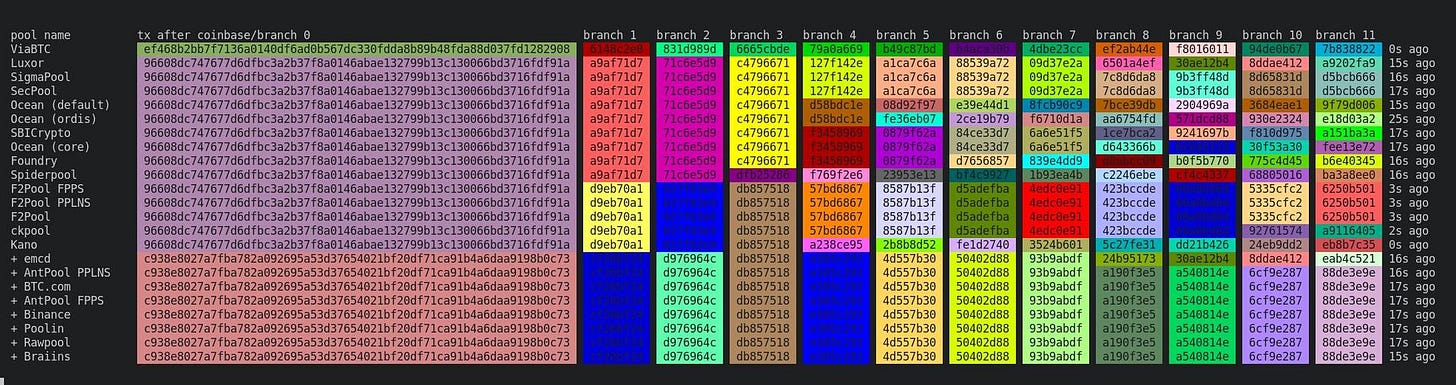
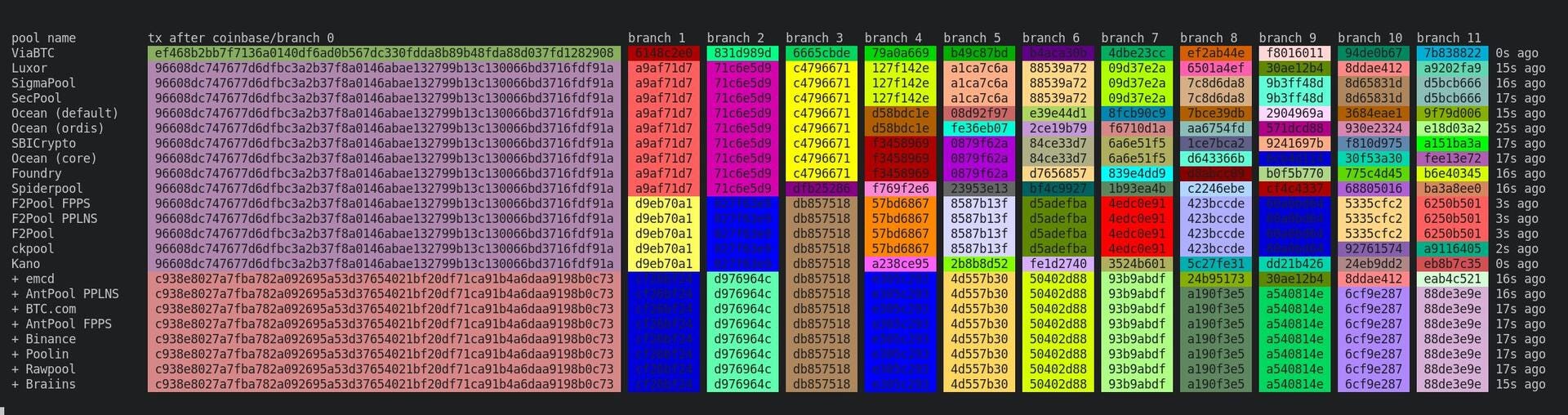
A chart depicting the distribution of merkle branches among mining pools, including BTCcom, Binance Pool, and Poolin, reveals several major mining pools using the same template and custom transaction prioritization as AntPool
This phenomenon may stem from the partnership between AntPool/Bitmain and FPPS, suggesting mining centralization.
Client-Side Validation: Best Approach for Cross-Layer Asset Migration?
CSV offers several advantages over bridge solutions. Also, “This protocol requires built-in migration mechanisms within the asset protocols of different chains. The challenges of designing, compatibility with existing asset protocols, still exist.”
What Is the DNA of Digital Goods and How Does It Work?
Beyond Loot: Unleashing the Potential of Spore DOB-0 Protocol discusses how the Spore DOB-0 protocol extends content stored in Cells beyond simple text to DNA, allowing individual DOBs to acquire a "birth chart" based on their creation time and space — block height and Cell ID.
DNA enables Spore to surpass Loot in randomness and combinability, inspiring broader imagination and richer development possibilities.
Self-Proclaimed Satoshi Craig Wright Discontinues Lawsuit Against Bitcoin Developers
Craig Wright, who once claimed to be Satoshi Nakamoto, recently dropped his lawsuit against 12 Bitcoin developers, marking the end of nearly a decade of harassment and intimidation. This allows developers to freely contribute to the Bitcoin network without fear of litigation or harassment, seen as a victory for Bitcoin developers and the open-source software community.
Prior to this, a related lawsuit “Identity Trial” determined that Craig Wright is not Satoshi Nakamoto.
UX and Meme Design Challenges in Bitcoin (Pay in Sats)
The Design_r community on Stacker News focuses on Bitcoin-related designs, listing a series of Open Design Challenges and Comic & Meme Contests, where anyone can participate without permission.
22 Hackathon Projects from Autonomous Worlds 2024 Summit
The Autonomous Worlds summit 2024, themed "Modding. Extendability. Composability," took place in Lisbon, Portugal, from April 16th to 18th. Game developers @damor_eth summarized and presented 22 promising projects.
This event was not merely presentations and discussions; it resembled a mix of a hackathon and a game jam ("mod jam") as the emphasis was on "more doing, less talking."
Top Reads on Blockchain and Beyond
Enhancing Bitcoin Layer 1 Programmability with the RGB++ Protocol
How RGB++ makes programmability possible without compromising Bitcoin's security and decentralization.
The article includes code samples for semi-fungible tokens, Initial Bitcoin offering, and staking & rewards.
Enhancing Bitcoin Security Through Soft Forks
This article reviews the soft forks implemented in Bitcoin to enhance security, such as disabling
OP_RETURN,OP_CAT, and preventing identical transaction IDs, showcasing Bitcoin's progress in transaction security.The article aims to dispel the tendency to deify Satoshi Nakamoto – the belief that the system he created is flawless and does not require improvement (at least not structurally, only parameter changes) – which is a dangerous notion, pointing out the various efforts made to improve Bitcoin over time.
Permit: How a Mundane Signature Can Deceive Your Assets?
According to the March Phishing Report released by Scam Sniffer, 90% of the phished assets were ERC-20 tokens, with Permit / Permit2 phishing signatures being the primary method.
A considerable number of dApps have adopted the Permit / Permit2, allowing users to directly authorize tokens to the middle-man Permit / Permit2 without individually approving each contract, saving gas fees. DApps integrated with the Permit / Permit2 only require a simple signature for authorization (even in bulk), eliminating the need to repeatedly spend gas for approvals.