
HaCKBee Digest: Bitcoin Finance, Digital Objects, BitVM, and More
Your weekly scoop from the Bitcoin ecosystem. All things tech and innovation! #POW #UTXO #BTC

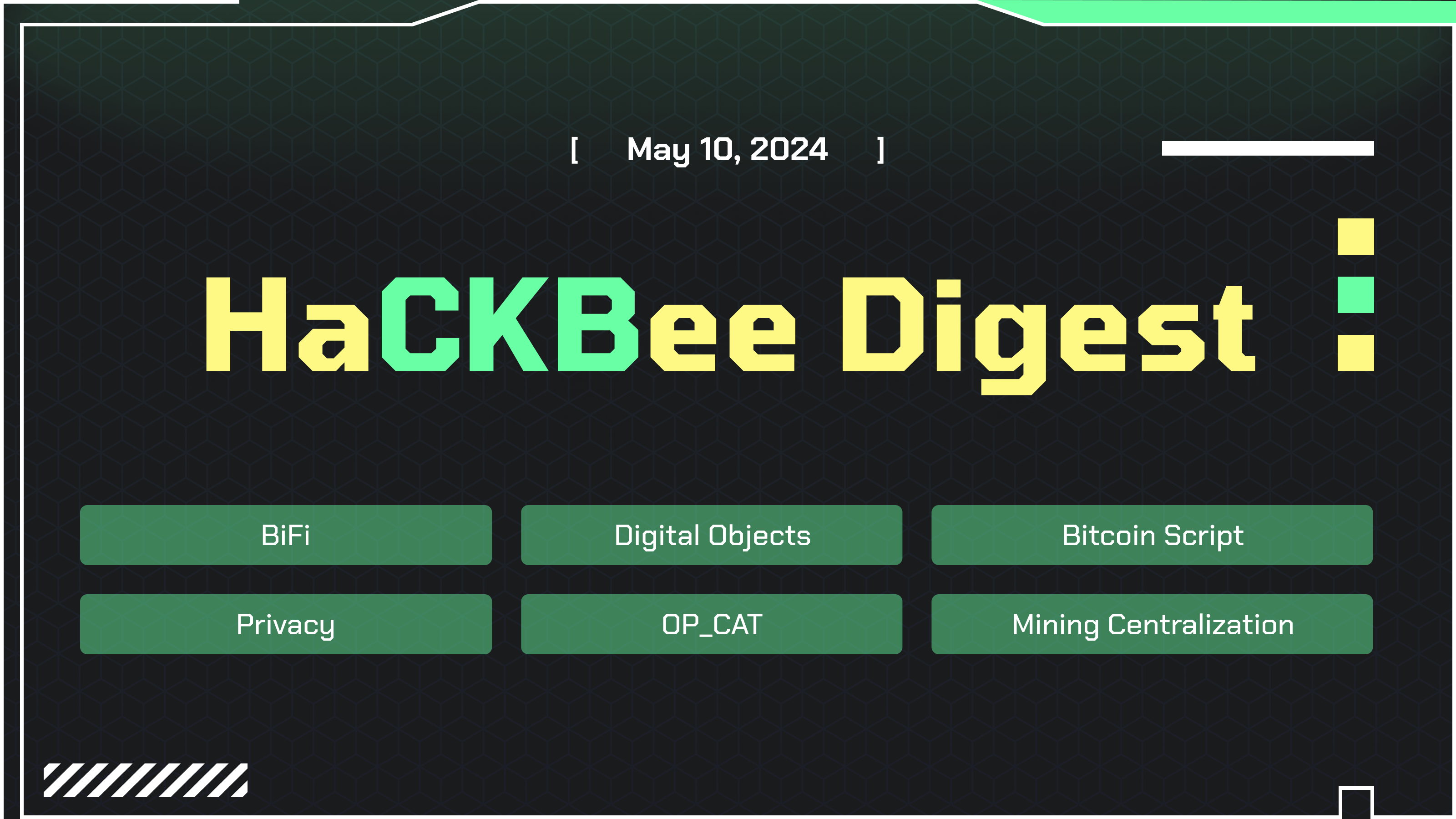
Highlights
Intent-Based DEX Enhancing Bitcoin Eco Trading
LIMO: Merging Linearization Search for Efficiency
BitVMX Whitepaper Explained: A CPU for Universal Computation on Bitcoin
Pseudonymity Vs. Anonymity: Understanding Privacy in Bitcoin
Crypto Insights
Coffee Maker Activated by Sats Payments Using Lightning Network
This coffee machine is comprised of a Bosch coffee maker, Lilygo T-display, 5V solid-state relay, and JST-SH 1.0mm connectors. The software is based on Ben Arc's BitcoinSwitch project.
Users can make coffee by paying Sats via Lightning Network.


UTXOSwap: Intent-Based DEX Enhancing Bitcoin Eco Trading
UTXOSwap uses an intent-based hybrid transaction model, enabling both automated market maker (AMM) and off-chain orderbook.
It currently supports the trading of assets within the RGB++ and CKB ecosystems, with plans to expand support to other BTC ecosystem assets such as Runes.
Advantages including: swaps with nearly 0 Gas with any token to pay, support for user-customized AMM curves and fee rates, native compatibility with multi-chain wallets, and seamless operation between Layer 1 and Layer 2s.
What makes DOBs Better than NFTs?
DOBs are fully on-chain, including their DNA and decoder.
They are native to Bitcoin, thanks to RGB++.
Immutable once deployed, ensuring ownership rights.
Owners have full control and can apply customizable ownership contracts.
LIMO: Merging Linearization Search for Efficiency
LIMO, short for Linearization through Incremental Merging of Optimizations, addresses the inefficiencies of existing linearization algorithms in cluster management. By integrating computational search techniques and incremental merging, it optimizes linearization processes to ensure the highest feerate transactions are prioritized efficiently.
LIMO not only improves upon existing linearization strategies but also offers potential applications in cluster updates, further enhancing transaction management in complex environments.
New BIP Proposal: Restoring Bitcoin Script Features Removed in Bitcoin v0.3.1
Bitcoin v0.3.1 significantly removed Bitcoin Script features to avoid DoS attacks. This proposal by Rusty Russell utilizes weight-based opcode budget to handle variable-length stack values, relaxing the previous limit of 520 bytes per stack entry and allowing arbitrary length values.
BitVMX Whitepaper Explained: A CPU for Universal Computation on Bitcoin
BitVMX is a new virtual CPU design for verifying arbitrary programs on the Bitcoin chain, adopting a new "challenge-response" game protocol and a simpler computational model.
Unlike BitVM1 and BitVM2, BitVMX doesn't rely on complex structures like Merkle trees or signature equivocations. Instead, it utilizes a hash chain to balance programming costs and complexity.
Pseudonymity Vs. Anonymity: Understanding Privacy in Bitcoin
In the context of Bitcoin, the terms "pseudonymity" and "anonymity" are often confused. Pseudonymity refers to using a fictitious name to conceal identity, where the addresses used are not linked to the user's real identity unless disclosed. Transactions can be non-anonymous but still private because the user's identity remains hidden.
Anonymity refers to completely concealing one's identity, achievable through techniques like coin mixing and anonymous marketplaces. Coin mixing combines transactions with those of other users, making it difficult to trace the original source. Anonymous marketplaces allow users to buy and sell using Bitcoin without revealing their identity.
OP_CAT Opcode in Tapscript Got Merged
BIP 347 defines
OP_CATas a new Tapscript opcode, allowing concatenation of two values on the stack. This opcode can be activated via a soft fork by redefiningOP_SUCCESS126.
Top Reads on the Blockchain and Beyond
Two Pieces on Lamport Signatures
1. Script State from Lamport Signatures
Explains how Lamport signatures can be used to create a global state for settling smart contracts in Bitcoin transactions.
2. Signing a Bitcoin Transaction with Lamport Signatures With No Changes Needed
A series of exchanges among programmers and cryptographers focusing on the implementation and implications of ECDSA and Schnorr signatures in Bitcoin’s script language.
A big portion of the discussion is on integrating Lamport signatures into Bitcoin, addressing implementation challenges and security risks. Concerns include vulnerabilities to quantum computing, prompting innovative solutions like fixed 'r' values in signatures and exploring new scripting methods for covenants without using extensive opcodes.
OP_CAT: The Purr-fect Solution for Covenants?
OP_CAToffers significant power with just 10 lines of code, addressing three initial limitations of BitcoinScript: linear execution model (lack of looping), lack of basic arithmetic, and lack of transaction data visibility.While far from elegant,
OP_CAToffers the best balance between power and complexity, enabling developers to create remarkable new features.
Centralization in Bitcoin Mining: Understanding the Balance Sheets
A recent research reveals concerning levels of centralization in Bitcoin mining, with a single entity controlling the coinbase outputs for approximately 47% of the network hash rate.
Analyst Alex Bergeron suggests that miners aim to minimize revenue variance, leading entities with substantial balance sheets to assume this risk.
Analysis suggests that only around $20 million in capital may be needed to manage this variance, indicating that while centralization poses immediate challenges, the long-term incentive dynamics may not be as fundamentally compromised as perceived.
Bitcoin and Biodiversity in the Cannabis Industry
The role of fiat currency comes into play when big companies patent plants to secure profits, limiting biodiversity and causing issues for farmers.
Bitcoin addresses a key challenge for the cannabis industry: transaction settlement. Traditional banking is unavailable, leaving businesses reliant on cash, which is risky and impractical. Bitcoin offers a secure, non-intermediated alternative, allowing businesses to conduct transactions without banks or payment processors.