
Beyond Loot: Unleashing the Potential of Spore DOB-0 Protocol

Spore is a universal digital object creation protocol deployed on Nervos CKB, supporting various content types such as images, links, videos, audio, text, and code (e.g., Lua scripts, Markdown). Digital Objects (DOB) generated by Spore are both tamper-proof and entirely stored on-chain.
Spore DOB-0 protocol is developed on top of Spore, leaning towards the application layer. Its association with Spore resembles the relationship between the HTTP and TCP. Spore DOB-0 protocol aims to create a flexible DNA byte rendering process, simply put, how to parse the DNA of DOB. Despite its brevity, the protocol holds boundless potential.
Implementation of the Spore DOB-0 Protocol
Spore DOB-0 protocol sets a new standard for the "text" content type. Instead of ordinary text, the most critical aspect of the DOB — its DNA — is stored in the CKB Cell. The on-chain Decoder subsequently interprets the DNA according to the Pattern. The frontend eventually renders and displays the DOB to the user.
The process is illustrated as below:
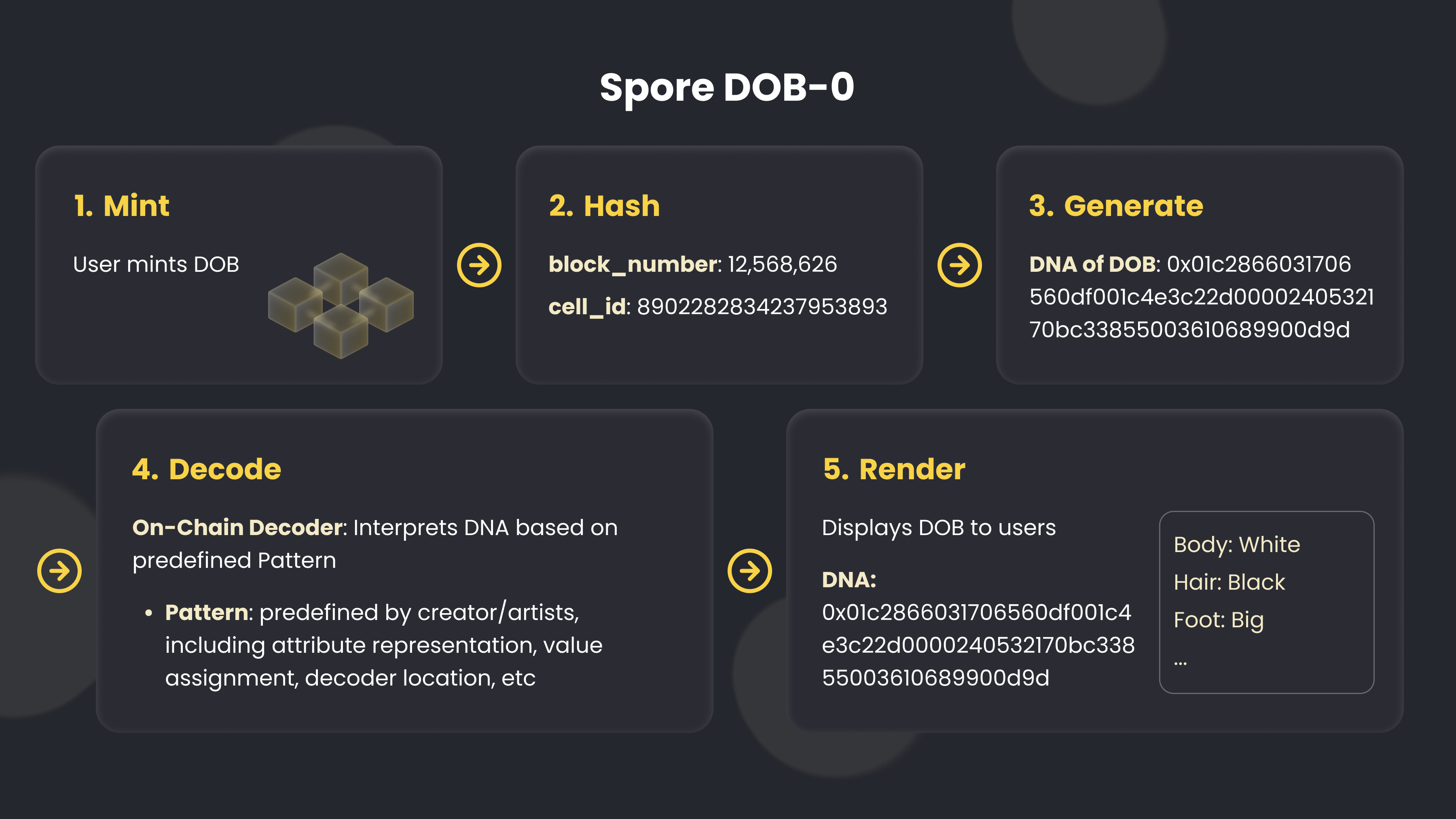
Step 1-2:
When minting a DOB, the on-chain contract hashes the current block height and Cell ID. The resulting hash becomes the DOB's DNA.
Step 3-4:
The Decoder deployed on CKB decodes the DNA using the pre-defined Pattern, provided by the creator or artist. The Pattern is a segment of bytes that can be binary numbers, strings, or any format determined by the Decoder. The creator or artist defines and uploads the Pattern before users minting DOBs. Pattern dictates attribute representation, value assignment, and Decoder location, etc..
Step 5:
Finally, the frontend (wallet, browser, trading platform, etc.) renders and presents the DOB to the user based on the decoded content from the Decoder.
In this process, creators and artists must prepare Patterns and Clusters in advance. Think of the Pattern as a cipher book determining how a DOB's DNA is interpreted, and where the DOB’s attributes are defined and assigned.
The Spore development team plans to release a tool to streamline operations, allowing creators and artists to directly create a Cluster Cell on-chain with the Pattern included, as easy as completing a fill-in-the-blank exercise. A Cluster acts like a Collection, but is more flexible and independent. By creating a Cluster and providing its ID in the DOB, users can mint Spore DOBs belonging to that Cluster. Clusters serves as directory indexes for Spore DOBs.
Protocol developers need to deploy Decoder contracts on CKB in advance and make their addresses public. The Decoder decrypts the DNA information based on the cipher book, i.e., Pattern. With CKB being a permissionless public blockchain, as more DOBs adopt the Spore DOB-0 protocol standard, various Decoders will be deployed, and even tailored for particular purposes, available for creators and artists to choose from.
For users, minting a Spore DOB of a particular Cluster is straightforward as long as they know the Cluster ID disclosed by the creator or artist.
Originating From Loot, Surpassing Loot
Spore DOB-0 protocol draws inspiration from Loot, an adventurer gear generated and stored on Ethereum. It only comprise words. Numbers, images, and any other content are intentionally omitted, allowing for diverse and more imaginative interpretations.
Loot directly writes the attribute pools (Pattern in Spore) in the contract, making the Decoder and Pattern highly coupled. Therefore, one Loot contract only reflects a single NFT theme. Unlike Loot, Spore DOB-0 decouples Pattern and Decoder, further enhancing composability. Given the same set of Decoders, coupled with different Patterns, the result can be completely different.
In terms of random number generation, Loot provides only one dimension, i.e., generating a single random number, used by all attribute pools. By contrast, when minting a DOB via Spore DOB-0 protocol, a DNA string is generated. Different segments of the DNA can be used as random numbers for different attributes defined in the Pattern, providing a wider range of randomness.
When it comes to overall design, Spore DOBs embody a more intriguing philosophical perspective. Firstly, minting a DOB requires obtaining CKB tokens as "raw materials," while melting it enables the retrieval of the occupied CKB. This imbues DOBs with a sense of vitality and mortality, integrating the concept of life and death.
Secondly, the universe contains time and space. PoW, the consensus mechanism adopted by Nervos, functions as a decentralized clock, while the Cell serves as a repository for various content types. The combination of PoW + Cell enables the creation of a decentralized universe atop CKB. Here, DOBs hash the time and space (block height and Cell ID) upon birth, resulting in their unqiue "astrological chart", i.e., DNA. Thus, minting a DOB via Spore DOB-0 protocol embraces a certain degree of randomness, mirroring the unpredictability inherent in the birth of all living beings.
One feature of a hash function is collision resistance, meaning that changing just one character in the input information will produce a completely different hash value, ensuring that each DOB's DNA is unique, the same as the DNA of every living being in the real world.
Cells, the fundamental unit of Nerovs blockchain, contain DNA, preserving vital information of an organism. By nurturing cells, we eventually obtain a living organism, which can further mate and reproduce. Minting DOB via the Spore DOB-0 protocol is highly flexible and composable. Users can enrich the content expressed by DNA according to their preferences, and display through various methods such as drawing, modeling, music, textual descriptions, etc. They can even integrate large AI models.
Spore offers other advantages over Loot, including zero transaction fees for on-chain DOB transfers (miner fees), each DOB’s value being backed by CKBytes, among many others. For further exploration, refer to the article Spore Protocol Simplified.
Envisioning the Future Spore DOB-0
Like Lego blocks, Spore DOB-0 protocol separates Pattern, DNA, and Decoder, bringing flexibility and composability, providing unlimited possibilities for the future development.
DOBs minted via Spore DOB-0 protocol are the genesis, from which individuals can further develop, enhance, and enrich, generating secondary and tertiary creations. For instance, enthusiasts of visual art can input the decoded DOB DNA into AI drawing tools to produce diverse imagery; those fond of cinematic productions can feed the result into AI video tools like Sora to recreate DOBs in films and videos, while literary aficionados can incorporate DOBs as characters within novels.
DOBs minted through the Spore DOB-0 protocol also exhibit openness and scalability. Other blockchain projects can reference these DOBs. For example, a whole-chain game or a GameFi project can directly reference DOBs as the underlying database for character, weapon, and equipment information in the game project. Moreover, the same set of DOBs can be used in different games, overcoming the limitations of traditional Web2 games where items, weapons, etc., cannot be used across games.
In conclusion, the openness, flexibility, composability, and scalability of the Spore DOB-0 protocol provide limitless imagination space, allowing it to build various possibilities. No one can accurately predict what will happen in the future, but the ecosystem development based on the Spore DOB-0 protocol is definitely worth looking forward to.
The original article: 超越 Loot:探索 Spore DOB-0 协议的无限可能